
(BlackFitness101.com) Folks love to talk about the stationary bike like it belongs in the corner reserved for people who just signed up and cannot figure out where else to stand. They stroll past it, glance at somebody pedaling with a magazine propped up, and decide right then that nothing serious happens over there. I have watched grown men who bench real weight skip it completely, convinced a padded seat and two pedals could never humble them. So I put a few of them on one, turned that tension knob until it bit, and their whole confidence melted before the timer hit 4 minutes.
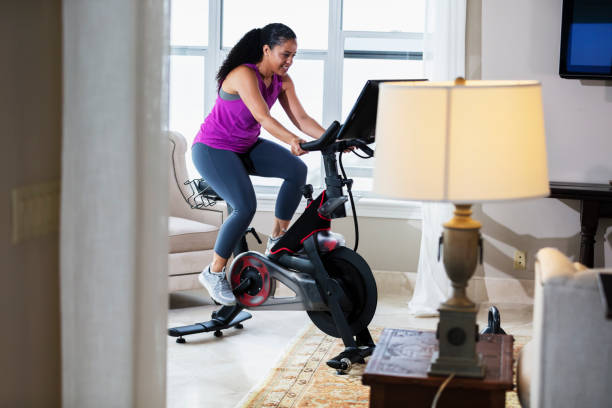
Let me tell you what nobody wants to sit with. The machine is only as soft as you allow. Most people wander off feeling like they wasted their time because they never once respected the dial that controls the entire experience.
That knob is where the whole myth collapses. Spin with nothing pushing back and yes, you may be doing little more than moving your legs. Your heart barely notices, your breathing stays comfortable, and you might as well be rocking in a chair on the porch. Add real load though, the kind that forces your quads to argue with every rotation, and suddenly the ride becomes a grind that can leave your lower half feeling like it survived a serious training session. I tell my clients to imagine climbing a hill so steep their bicycle wants to tip backward. That is the setting where your heart rate climbs and your legs finally have to produce some force. Softer work can serve as a warm up or recovery ride, but it will not deliver that same challenge.
Cadence gets slept on too. Plenty of folks assume faster automatically means harder, so they flail their feet like they are running from something with no tension underneath. All that gets you is sloppy form and possibly a sore lower back. Real work lives in the marriage between how quickly you spin and how much resistance you are driving against. Grind slowly under a heavy load and you challenge muscular strength and endurance through the lower half. Move quickly against moderate pressure and your lungs can light up like you sprinted a full block. Learning to read your own body, knowing when to hammer down and when to float, separates somebody serious from somebody killing time.
Standing up changes the equation as well. Lift yourself off that saddle, add some resistance, and now your core and upper body have to work harder to keep you stable while your legs continue driving the pedals. Sink back down and spin lightly for a spell to recover, then rise again when you are ready to suffer some more. Changing your position shifts the demand and keeps one movement pattern from carrying the entire session. Anybody who plants their behind and pedals the same lazy way for half an hour should not be surprised when the results match the effort.
Now let me talk about intervals, because this is where the real magic hides. Steady pedaling at one pace for 30 minutes has its place. It calms the mind, keeps the blood moving, and can do a body good on a recovery day. But if you want to test your conditioning, you chop that session into war. Give me 30 seconds of nearly everything you have, legs burning and breath ragged, followed by a slow crawl to gather yourself. Then you do it again. And once more. Eight rounds of that can leave you in a puddle nobody expects from a padded little seat. I had a client once who ran track in college and figured she would breeze right through it. Halfway in she was folded over the handlebars admitting she had badly underestimated the session. I backed her down, gave her time to recover, and reminded her that hard work should never mean ignoring dizziness. Here comes the sneaky part. Your body does not return to its resting state the second you stop. A demanding interval ride can keep oxygen use and energy expenditure slightly elevated during recovery, even though most of the calorie burn still happens while you are exercising.
Duration matters more than people give it credit for, but do not dismiss a quick 10 minute effort. A short ride can still improve fitness, support your health, and add meaningful movement to the day. Longer sessions simply give you more time to build endurance, accumulate work, and expend energy. Your body uses a changing mixture of carbohydrates and fat throughout the ride, depending on the intensity, your fitness level, what you have eaten, and how long you keep going. Stretch a smart session past 40 minutes with shifting resistance and changing speeds, and you have accomplished something that can rival a long jog without exposing your joints to the same repeated impact. That last part is why I love recommending it to older clients and anybody managing sore knees or ankles. You can work hard without every step landing against the floor.
Somebody reading this is thinking their spin class already handles all of that. Maybe it does. A good instructor shouting over loud music and pushing you through climbs and sprints can absolutely wreck you in the best way. But plenty of classes coast. The teacher counts to 8, everybody nods, nobody actually turns the knob, and the whole room pedals through a glorified group nap set to a decent playlist. Effort is a choice you make with your own hands. Nobody can grip that dial for you.
The little screen up front is where you turn all of this into a weapon. Watts, heart rate, cadence, distance, time, and resistance level can tell you exactly how much work you are producing. When your legs beg you to ease up, that number may be the reason your hand stays away from the dial. If your cadence starts sliding near the end of a sprint, the readout catches you slacking and dares you to hold the line. I have my clients hunt real proof, a heavier climb than last week, one more controlled round than they believed they had in them, or breathing that settles faster after the same hard effort. None of that is vanity. That is how you keep a program progressing instead of letting it become comfortable.
The beauty of it is how honest the thing turns out to be. It never lies about what you put in. Coast and it lets you coast. Attack it and your legs may remind you about that decision when you get out of bed the next morning. I have written whole programs around this machine. Some were for women who took one look at a barbell and wanted no parts of it. A few were for guys returning from surgery who needed to move without placing unnecessary stress on a healing knee. One grandmother of mine simply wanted to feel strong in her own skin, and she found that feeling right there on the seat. Every single one of them stopped calling it easy after their first honest session.
So the next time you spot that thing sitting quietly in the corner, understand it is not waiting for a beginner. It is waiting for somebody bold enough to discover what it can really do. Turn the resistance up. Play with your speed. Rise out of the saddle when your balance and fitness allow it. Break the workout into brutal little sprints and steady climbs. Stay on long enough to challenge your endurance. Do all that and you will never again make the mistake of thinking a seat and two pedals belong to the weak. That corner holds one of the most punishing tools in the entire building, and most folks walk right past it every day, clueless about what they missed.
Staff Writer; Nina Brown
This queen brings over 10 years of fitness training experience, uplifting clients with real guidance, steady motivation, and a heart for healthier Black communities.
Questions? Feel free to email me at; NinaB@BlackFitness101.com.