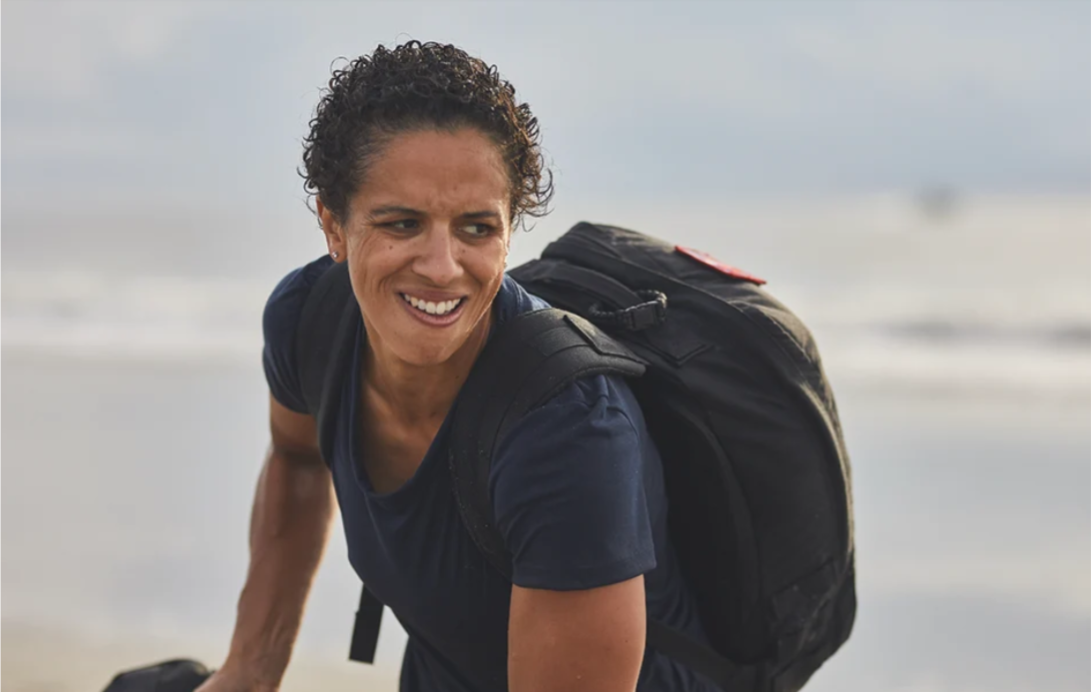
(BlackFitness101.com) Most women who walk into my studio past 50 want the same three things: stronger legs, steadier balance, and a workout that won’t punish their knees, so when Ms. Yolanda, 57, asked me about rucking, I figured it deserved a shot. My girl showed up with an old book bag borrowed from her grandson, two jugs of water wrapped in a beach towel, and a look on her face that dared me to say something. I didn’t. We did one slow mile around the church parking lot, and by the end Yolanda was sweating and fussing and grinning all at once.
That was two summers ago. Still rucks, every single week.
If the word sounds strange, it comes from the military. Soldiers march for miles with heavy packs strapped on, and at some point regular folks looked at that and said, well, why not me? You put weight on your back, or wear a weighted vest, and go walk. That’s it. No gym membership, no fancy class, no mirror to stare at yourself in.
The question I keep getting, mostly from women in my own age bracket, goes something like this. “Coach, I already walk. Do I really need to carry stuff too?”
Not always. But there’s a reason I like it with some of my over 50 crowd.
Here’s what nobody tells you at 35. Muscle starts gradually slipping away earlier than most of us realize, and by the time we reach our 50s and beyond, keeping what we have takes more work. For women going through menopause, protecting bone health becomes especially important too. A regular stroll is wonderful for your heart and your head, and I’d never talk anybody out of it. It just may not challenge your muscles as much once you’ve been doing the same route at the same pace for a long time. The body adapts. Smart like that.
Throw twelve pounds on and the conversation changes. Now your hips have a job. Glutes too. Those muscles between your shoulder blades, the ones that have been slumped over a phone for ten years, finally get called in to work.
Your bones need regular weight bearing activity too. I won’t pretend a backpack is going to reverse osteoporosis, because it won’t, and anybody promising that is selling something. Walking and resistance exercise are both recommended for bone health, but research has not proved that putting extra weight in a vest or backpack gives older adults some special bone building advantage. What it can do is make an ordinary walk more physically demanding.
Then there’s your heart rate. Ooh. I had a client, Darnell, 58, retired mail carrier, tell me cardio “wasn’t for him” because jogging wrecked his knees. Put twenty pounds on that man at a normal pace up the hill behind the rec center and he was huffing like he’d just finished a 5K. “Thirty years walking routes,” he said, “and you found a way to make it hard.” No running. No jumping. Just walking under a little more load.
Now. This part matters.
If your doctor has mentioned osteoporosis, a bad disc, heart trouble, balance problems, or another condition that affects how safely you exercise, please check with them before you load anything. I mean that. Some of my people spent three, four months doing chair squats and plain laps around the block before I let them near a pack, and they’re thriving now because we didn’t rush.
Okay, so you want to try. Here’s roughly how I start folks.
#1 – Light. Lighter than you think. Five to ten pounds for the first few weeks. I don’t care if you deadlifted in college.
#2 – Vest or backpack, either works. Vests hug your middle, and a lot of my older clients say their low back likes that better. If you go with a bag, pack it high and tight. Heavy stuff down by your tailbone can pull you backward, and you’ll hear about it the next morning. Wrap jugs or plates in a towel so they don’t shift around.
#3 – Stand up tall. Chin level, shoulders down. A tiny lean from the ankles is fine. Hunching is not.
#4 – Wear comfortable, supportive walking shoes. Not the cute flats.
#5 – Add minutes before you add pounds. Twenty minutes on flat ground is plenty for week one. When forty five feels easy, go up a couple. Not ten. A couple.
#6 – Two or three ruck days a week is where I start a lot of my people. On the rest, stroll plain, stretch, lift, garden, whatever. Joints need a breather.
Sore thighs the next day? That can happen when you’re asking the muscles to do something new. Sharp pain in a knee or hip or foot? Not something to push through, so stop. An achy neck may mean the straps are off or the load is riding too low. And if you can’t catch your breath even after slowing down, that’s a doctor visit, not a toughness test.
What surprised me most is how social this got. Ms. Yolanda recruited three ladies from her Sunday school class, and these days there’s a little crew of them every Saturday at 7, packs on, talking about everybody’s business for a couple miles straight. Nobody checks a watch. I wish I could get that kind of consistency out of my paying clients.
So is it better than regular walking? Not automatically. But for some folks over 50, it can be a simple way to make a familiar walk more challenging without having to start running or learn a complicated workout. Some of y’all might be better off with a plain stroll for the time being, and I’ll cheer just as loud. The routine that wins is the one you’ll still be doing next spring.
Start light. Stand tall. And if you see a woman at the park with a towel wrapped around two gallons of water on her back, wave. It might be Yolanda.
Staff Writer; Nina Brown
This queen brings over 10 years of fitness training experience, uplifting clients with real guidance, steady motivation, and a heart for healthier Black communities.
Questions? Feel free to email me at; NinaB@BlackFitness101.com.