
(BlackFitness101.com) Most women who find their way to me after 50 are worried about knees, lower backs, that one cranky shoulder. Almost nobody shows up asking about the outer hip. That quiet little zone, though, does far more for how you carry yourself through a day than it ever gets thanked for.
Let me paint you a picture I run into constantly. Imagine a sharp, active woman in her late 50s who laces up and logs 3 or 4 miles most mornings. Proud of those miles, as she should be. For years she figured all that time on her feet had every corner of her lower body covered. Then one afternoon she slips a light loop around her thighs and tries a handful of slow side steps. Ten reps in, her whole expression shifts. “Why is this so hard?” she asks me. And I just smile, because that right there is the lesson.
Here’s the mechanics of it. Forward walking keeps you moving in one straight line, the same groove over and over. Your abductors, the gluteus medius chief among them, are working during those walks, but they may not get the focused resistance needed to build greater strength. Their assignment becomes especially important when you move sideways or balance on a single leg. Each time your weight lands on one foot, those muscles help hold your pelvis level so you don’t dip, sway, or wobble. When they aren’t pulling their weight, other parts of your body may compensate, sometimes contributing to knee discomfort or an aching lower back.
There’s a part nobody warns you about. After 50, muscle strength can gradually decline, especially when regular resistance training isn’t part of the picture. For women navigating the changes that come with aging, those smaller stabilizing muscles deserve attention too. You can stroll for decades and still leave that specific area without enough resistance training. That’s no knock on walking. It simply wasn’t built to cover every angle your frame needs.
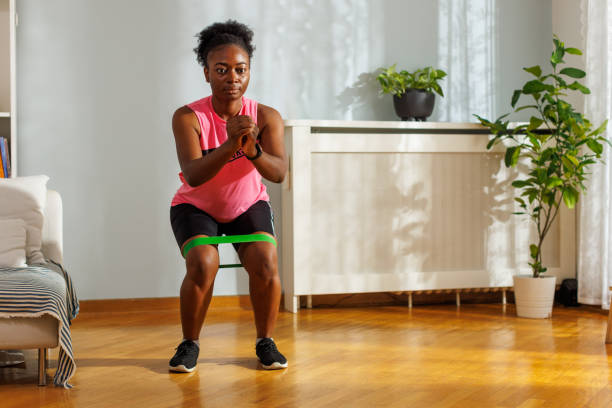
The elastic is what turns something so small into something so honest. Tension tugs your legs inward, so those stabilizers have to press out against it with every move. Soft knees, tall chest, toes aimed straight ahead, and go slow. Slow is where the whole payoff lives. Rushing hands the job over to momentum; control makes the target muscle earn it.
Starting out, keep it humble. Lighter resistance and a shorter travel distance beat heavy tension you can only fake your way through. Take 10 or 12 controlled side steps in one direction, then work your way back. Two rounds total are plenty for your first session. As it gets easier, increase the resistance or move the band lower toward your ankles, provided you can maintain good form. You might even tack on another round. Your body can adapt with consistent practice when you give it the right challenge on the regular.
So where does this fit with everything else you’re doing? Think of it as one slice of a bigger pie. Squats and sit-to-stands give your thighs and backside some needed work. Your glutes and hamstrings get their turn with bridges and good hinge exercises. What many programs overlook is the sideways stuff, and that’s the hole this fills. And it matters more than folks expect. You step over the edge of the bathtub. You catch your footing when the grass goes uneven under you. Maybe you’re squeezing down a crowded church pew, or stretching for something up on a high shelf with all your weight parked on one leg. Every bit of that calls on muscles that help stabilize your hips and pelvis. None of those moments announce themselves ahead of time. Life just hands them to you, and having a stronger foundation can make those everyday movements feel more manageable.
Now I’m going to be straight with you, the way I always am. Strong stabilizers absolutely support your steadiness. A pelvis that stays level gives your body a more stable foundation for movement, no argument there. But I’d be misleading you if I let you believe outer hip work by itself guarantees good balance. Staying upright is a separate skill, and it comes with its own homework. Practice standing on one foot near a sturdy counter, keeping a hand close enough to catch yourself if needed. Walk heel to toe along a clear stretch of floor, with a wall nearby for support. Those exercises belong in your week too, alongside your strength training. One builds the foundation underneath; the other teaches you how to use it.
As the seasons change, I always watch people quietly shrink their world. Morning walks get shorter, schedules grow crowded, and exercise becomes something they promise to return to later. Don’t you do that. Set aside 15 minutes, grab an inexpensive resistance band, and find a patch of open floor. Maybe 3 times a week, alongside your usual activities. That’s a reasonable place to begin. Think back to that imaginary walker from earlier. With several weeks of consistent practice, she might find the stairs feeling easier, her evening walks more comfortable, and the simple act of pulling on a sock less of a balancing act.
That’s how the small wins pile on. Bit by bit they can turn into the kind of comfortable, sure-footed movement that helps you keep running your own life, never mind what the candles on the cake say. Begin light. Stay with it. The version of you still moving around freely at 70 and 80 stands to benefit from the strength you choose to build today.
Staff Writer; Nina Brown
This queen brings over 10 years of fitness training experience, uplifting clients with real guidance, steady motivation, and a heart for healthier Black communities.
Questions? Feel free to email me at; NinaB@BlackFitness101.com.